Environmental data management
Environmental data you can defend.
Import laboratory and field data without losing the original record. CHEMDAS validates each file, standardizes values, and shows exactly what changed.
Remove client identifiers first if needed. You keep the findings even if CHEMDAS is not the right fit.
Import record · illustrative
Audit verifiedAs reported · untouched
0.0047 mg/L
Source value retained exactly
Canonical · derived
4.7 ug/L
×1000 · registry 2026-08-12.1
Source
lab_edd.xlsx
Rule
mass-conc-017
Chain
SHA-256 verified
Shipped platform facts
- 3
- deliverable formats read end to end, each with its own parser
- 32
- tables and sheets routed by declared content signature, not by filename
- 24
- EPA-aligned sample classifications, including field and lab QC
- 15
- measurement dimensions in the canonical unit registry
How CHEMDAS works
From source file to usable data.
Keep the reported values. Add standardized values. Record each validation and change.
- 01
Preserve
Store the source faithfully.
- 02
Derive
Calculate standardized values alongside it.
- 03
Verify
Retain rules, actions, and integrity evidence.
- 04
Activate
Screen, trend, query, export, and integrate.
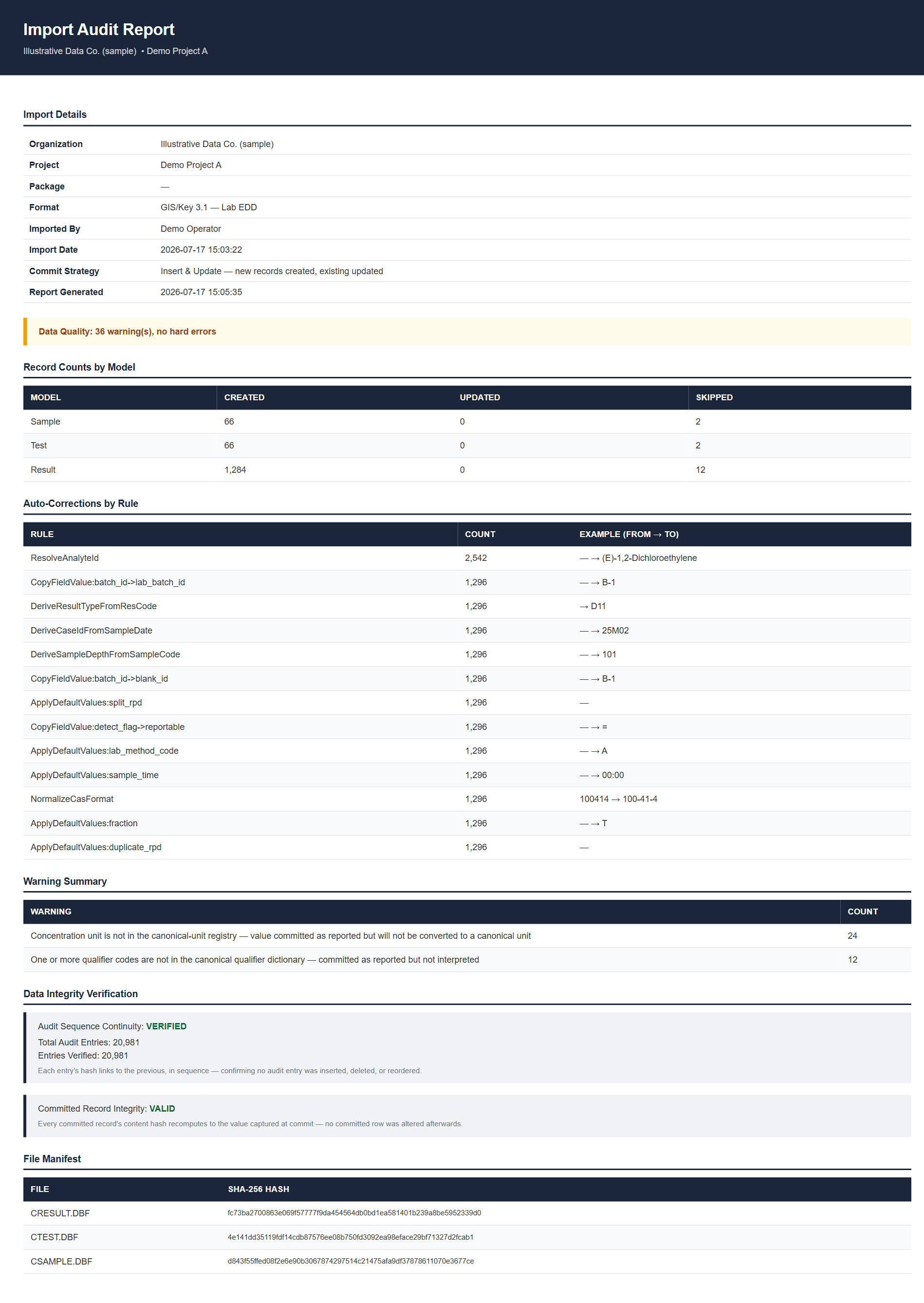
CHEMDAS Evidence Package
See what happened to every import.
Review the source files, validation results, transformations, unresolved values, skipped records, rule versions, and chain verification in one place.
Explore the Evidence PackageImport Audit Report
Illustrative sample data
Made for environmental work
Field records become decisions. Keep the path between them clear.
CHEMDAS connects laboratory deliverables with the work of data managers, project leads, and reviewers.
For environmental consultants
Evaluate with your own data
Test CHEMDAS with a real deliverable.
We run the file, identify unsupported conditions, and return findings you can keep.
Test a deliverable